
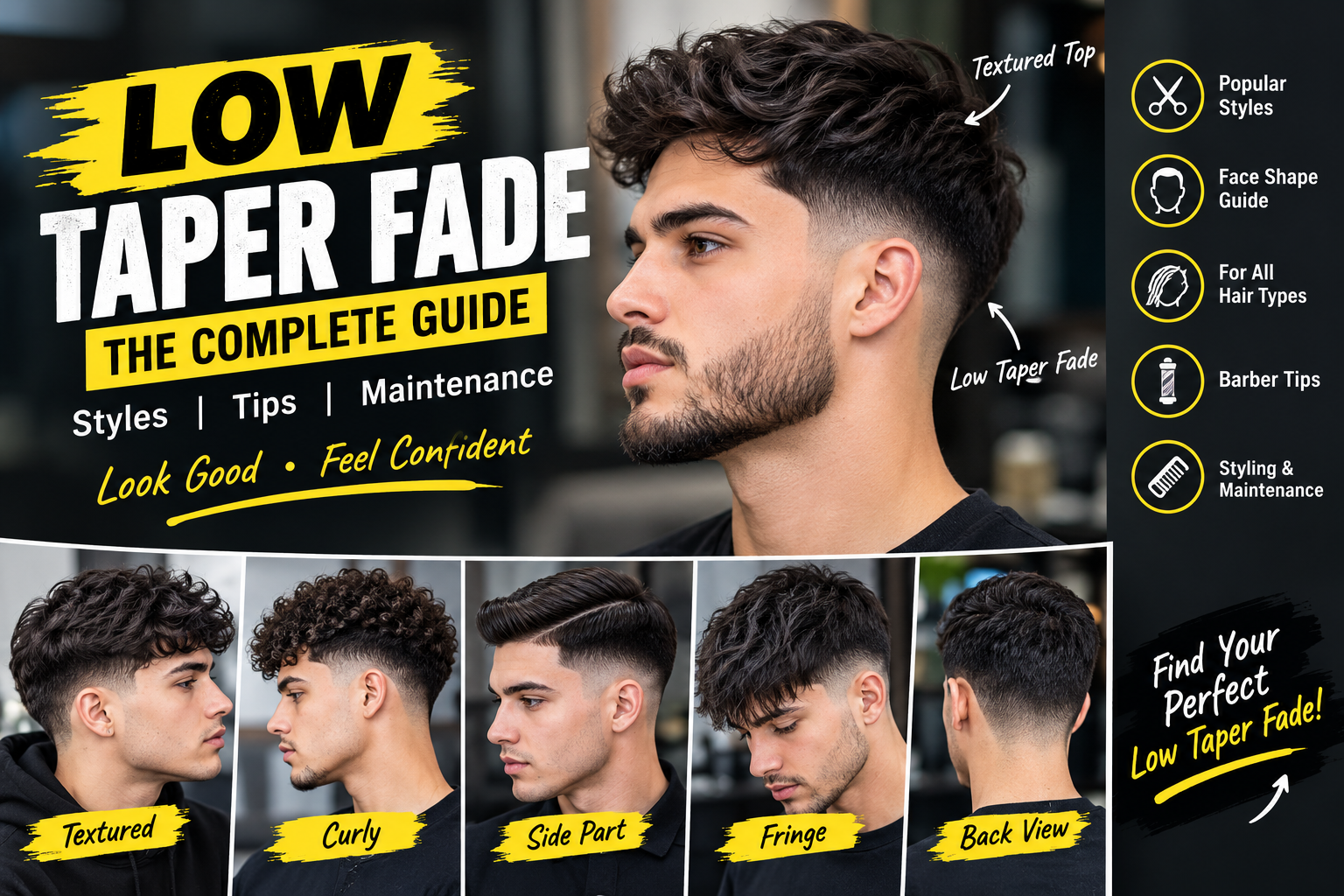
The low taper fade
The low taper fade is one of the most versatile modern men’s haircuts. It creates a clean transition around the ears and neckline while keeping more length and personality on top. Unlike higher fades, the taper stays relatively low, giving the haircut a subtle, balanced appearance.
Whether you have straight, wavy, curly, or coily hair, a low taper fade can be customized to suit your texture, face shape, lifestyle, and preferred top hairstyle.
What Is a Low Taper Fade?
A low taper fade is a haircut where the hair gradually becomes shorter around the lower sides, sideburns, and neckline. The transition is kept low rather than extending high toward the temples. This creates a neat silhouette while preserving plenty of hair on the sides and top.
The defining feature is the gradual blend. Instead of a harsh line between different lengths, the barber uses clippers and blending techniques to create a smooth transition. The top can then be styled as a crop, curls, quiff, side part, slick back, or textured hairstyle.
- Low blend around ears
- Clean neckline
- Gradual hair transition
- More side length
- Versatile top
- Natural appearance
- Suitable for beginners
- Easy to customize
Why Is the Low Taper Fade So Popular?
The popularity of the low taper fade comes from its balance between modern style and everyday practicality. It looks sharp without being excessively dramatic, making it suitable for school, work, social events, and casual settings. The lower fade placement also allows more natural volume to remain around the sides.
Another advantage is versatility. You can combine a low taper with short hair, long hair, curls, waves, textured crops, fringe, comb overs, or slick-back styles. Because the taper changes mainly around the perimeter, the haircut can be adapted without completely changing your overall appearance.
- Modern appearance
- Professional enough for work
- Works with many hairstyles
- Easy to personalize
- Keeps natural volume
- Low visual contrast
- Grows out naturally
- Suitable for many ages
Low Taper Fade vs Low Fade vs Mid Fade
Although the names sound similar, these haircuts differ mainly in where the blending begins and how much of the sides is reduced. A low taper fade focuses primarily on the sideburn and neckline areas, while a traditional low fade can remove more hair across the lower sides. A mid fade begins higher around the sides of the head.
Choosing between them depends on how noticeable you want the fade to be. If you prefer a subtle, conservative haircut, a low taper is an excellent option. If you want stronger contrast and a more obvious faded appearance, a low or mid fade may be better.
- Low taper: subtle blend
- Low fade: stronger side reduction
- Mid fade: higher transition
- High fade: bold contrast
- Taper preserves more length
- Fade can expose more scalp
- Low taper looks natural
- Choice depends on desired contrast
Best Low Taper Fade Styles for Men
One of the biggest advantages of a low taper fade is the number of hairstyles you can build around it. A textured low taper fade gives short hair movement, while a low taper with curls emphasizes natural texture. A side part or comb over can create a more traditional appearance, while a messy top offers a relaxed modern look.
You can also add a lineup, fringe, hard part, or subtle hair design for extra definition. The top length determines much of the haircut’s personality, while the low taper provides the clean foundation around the edges.
- Textured low taper
- Curly low taper
- Low taper with waves
- Low taper crop
- Low taper with fringe
- Low taper comb over
- Low taper slick back
- Low taper with design
Is a Low Taper Fade Good for Different Hair Types?
Yes, a low taper fade can work with virtually every major hair texture. Straight hair can be styled into a clean side part or textured crop, while wavy hair naturally adds movement to the top. Curly and coily hair can retain their natural texture while the taper creates cleaner edges around the ears and neckline.
The key is customization rather than using exactly the same haircut for everyone. Your barber should consider density, curl pattern, hairline, growth direction, and the amount of length you want to keep. This helps the finished taper look intentional rather than generic.
- Straight hair
- Wavy hair
- Curly hair
- Coily hair
- Thick hair
- Fine hair
- Dense hair
- Textured hair
Which Face Shapes Suit a Low Taper Fade?
A low taper fade is generally easy to adapt to different face shapes because the taper itself does not dramatically alter the upper silhouette. The hairstyle on top can be adjusted to create visual balance. For example, added height can elongate a rounder face, while controlled volume can complement longer or rectangular face shapes.
Instead of choosing a taper solely according to a face-shape chart, consider your hairline, head shape, hair density, and preferred styling routine. A skilled barber can adjust the top length, side volume, fringe, and neckline to create a proportionate overall appearance.
- Oval faces
- Round faces
- Square faces
- Heart-shaped faces
- Diamond faces
- Rectangle faces
- Adjustable top length
- Customizable side volume
How to Ask Your Barber for a Low Taper Fade
Clear communication is important, especially if this is your first taper. Tell your barber that you want a low taper fade around the sideburns and neckline, then explain how much length you want to keep on top. If you have a specific hairstyle in mind, mention it rather than simply asking for a fade.
A reference photo can make communication even easier. Show the barber the front, side, and back appearance you prefer when possible. You can also explain whether you want a natural taper, sharper lineup, textured top, curly finish, or a more conservative result.
- Say “low taper fade”
- Specify top length
- Mention your hair texture
- Explain your preferred finish
- Discuss the neckline
- Ask about the sideburns
- Bring a reference photo
- Confirm before cutting
How to Style and Maintain a Low Taper Fade
Styling a low taper fade mainly involves the longer hair on top. Start with slightly damp hair, establish your desired direction using your fingers, comb, or blow dryer, and then apply a small amount of suitable styling product. The product you choose should match your hair texture and desired finish.
Maintenance is relatively straightforward, but the cleanest appearance requires regular trimming. The exact schedule depends on how quickly your hair grows and how sharp you want the edges to remain. Keeping the top healthy and avoiding excessive product buildup can also help the haircut look fresher between barber visits.
- Wash hair regularly
- Use suitable styling products
- Start with little product
- Style the top first
- Keep edges clean
- Avoid excessive product
- Trim when the taper grows out
- Maintain the desired neckline
Is a Low Taper Fade Right for You?
If you want a haircut that combines a clean fade, natural side volume, modern styling, and everyday versatility, the low taper fade is an excellent choice. It provides enough structure to look polished while leaving the top open to countless styling possibilities. That makes it particularly useful for anyone who wants one haircut that works across multiple occasions.
Before your next appointment, decide how much length you want on top and whether you prefer a natural or sharper finish. Tell your barber exactly where you want the taper and bring a reference image if possible. With the right customization, a low taper fade can become a simple, stylish haircut that suits your personal look.
- Great first fade
- Versatile everyday haircut
- Works with many textures
- Easy to personalize
- Suitable for casual wear
- Works for professional settings
- Offers styling flexibility
- Clean and contemporary
Final Thoughts
The low taper fade stands out because it offers a strong combination of style and practicality. Its low placement keeps the haircut subtle, while the gradual blend creates a polished finish around the ears and neckline. With the right top hairstyle, it can be transformed into anything from a professional side part to a textured, curly, or modern street-style look.
For the best result, focus on communication, hair texture, face shape, top length, and maintenance rather than copying one exact haircut. The goal is a low taper fade customized to your features and lifestyle—not simply a generic fade.