
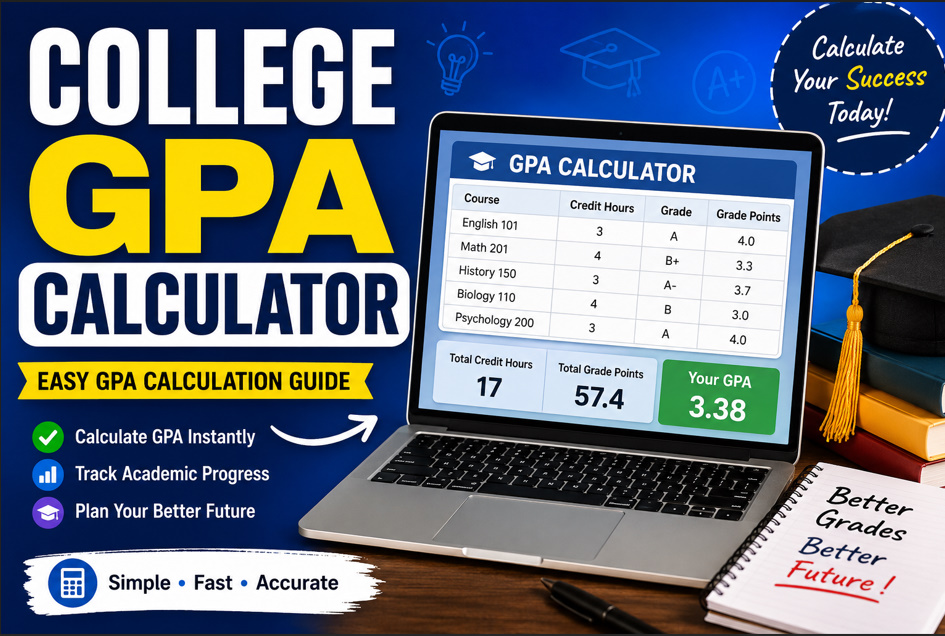
Your college Grade Point Average (GPA) is one of the most important academic measurements used by colleges and universities. It reflects your academic performance and often influences scholarships, internships, graduate admissions, financial aid eligibility, and employment opportunities. A College GPA Calculator helps students quickly determine their cumulative or semester GPA without performing complex calculations manually.
Whether you are a freshman trying to monitor your grades or a graduating senior preparing for higher education, using a GPA calculator makes academic planning much easier. This guide explains everything you need to know about calculating GPA, understanding grading systems, improving your scores, and avoiding common mistakes.
What Is a College GPA Calculator?
A College GPA Calculator is an online academic tool designed to calculate your Grade Point Average based on your course grades and credit hours. Instead of manually multiplying grade points by credit hours, students simply enter their course information, and the calculator instantly provides accurate results.
Most GPA calculators support semester GPA, cumulative GPA, weighted GPA, and unweighted GPA calculations. They are useful for students enrolled in community colleges, universities, online degree programs, and professional institutions.
Key Benefits
- Calculates GPA instantly
- Saves time
- Reduces calculation errors
- Supports multiple grading systems
- Tracks academic progress
- Helps with semester planning
- Useful for scholarship applications
- Easy for beginners
How Does a College GPA Calculator Work?
A GPA calculator follows a simple mathematical formula. Each course grade is converted into grade points, multiplied by the course credit hours, and then divided by the total credit hours completed.
For example, if you receive an A in a 3-credit course and a B in a 4-credit course, the calculator multiplies each grade point by its credits before averaging them. This process provides an accurate GPA within seconds.
Calculation Steps
- Enter each course
- Add credit hours
- Select earned grade
- Multiply grade points
- Total quality points
- Add total credits
- Divide quality points by credits
- Display final GPA
Understanding the College GPA Scale
Different institutions use different grading scales, although the 4.0 GPA scale is the most common. Understanding your school’s grading system is essential before calculating your GPA.
Many colleges also include plus and minus grades, resulting in values such as 3.7 for A− or 3.3 for B+. Some universities may use weighted systems or percentage conversions.
Common GPA Scale
- A = 4.0
- A− = 3.7
- B+ = 3.3
- B = 3.0
- C = 2.0
- D = 1.0
- F = 0.0
- Credit hours affect GPA
Why Your College GPA Matters
Your GPA represents your academic consistency throughout college. Universities, scholarship committees, employers, and graduate schools often review GPA when evaluating applicants.
Maintaining a strong GPA opens more educational and career opportunities. It can also improve your chances of receiving academic honors, research positions, exchange programs, and competitive internships.
GPA Is Important For
- Scholarship eligibility
- Graduate admissions
- Internship applications
- Academic honors
- Financial aid
- Student exchange programs
- Employer screening
- Professional certifications
Tips to Improve Your College GPA
Improving your GPA requires consistent effort rather than last-minute studying. Students who develop effective study habits often see gradual improvements throughout each semester.
Using a GPA calculator regularly helps you identify which courses require additional attention. It also allows you to estimate future GPA scenarios before final examinations.
Helpful Improvement Tips
- Attend every class
- Submit assignments early
- Review lecture notes daily
- Join study groups
- Meet professors regularly
- Manage study time
- Avoid missing exams
- Monitor GPA frequently
Common GPA Calculation Mistakes
Many students accidentally calculate GPA incorrectly because they forget to include credit hours or misunderstand their institution’s grading scale. Even small errors can produce inaccurate results.
Always verify whether your college uses semester GPA, cumulative GPA, weighted GPA, or another grading method before entering your information into a calculator.
Mistakes to Avoid
- Ignoring credit hours
- Using wrong grade scale
- Forgetting repeated courses
- Skipping failed classes
- Mixing weighted grades
- Incorrect data entry
- Rounding too early
- Not checking official policy
Features of a Good College GPA Calculator
A quality GPA calculator should be simple, accurate, and accessible on all devices. It should support multiple semesters and provide instant calculations with minimal input.
Many advanced calculators also include GPA prediction tools, cumulative GPA tracking, printable reports, and support for different university grading systems.
Best Features
- Instant calculations
- Mobile friendly
- Multiple semesters
- Cumulative GPA support
- Grade prediction
- Easy interface
- Accurate formulas
- Free to use
Frequently Asked Questions About College GPA Calculator
Students often have questions regarding GPA calculations, grading systems, and academic planning. Understanding these basics can help reduce confusion and improve academic confidence.
A reliable GPA calculator simplifies the process and provides accurate results that help students make informed decisions throughout their educational journey.
Quick Answers
- GPA measures academic performance
- Most colleges use 4.0 scale
- Credit hours affect GPA
- Semester GPA differs from cumulative GPA
- GPA calculators save time
- Accurate data produces accurate GPA
- Regular tracking improves planning
- GPA influences future opportunities
Conclusion
A College GPA Calculator is one of the most valuable academic tools for college students. It simplifies complex calculations, helps monitor academic progress, supports goal setting, and assists in making informed decisions throughout your educational journey.
Whether your goal is earning scholarships, qualifying for graduate school, improving your semester performance, or simply staying organized, using a reliable GPA calculator can make academic planning much easier. By understanding grading systems, tracking your GPA regularly, and following effective study habits, you can achieve stronger academic success and confidently work toward your future career goals.